
GRE: Gateway to Global Graduate Programs
Your Complete Guide to the Graduate Record Examination
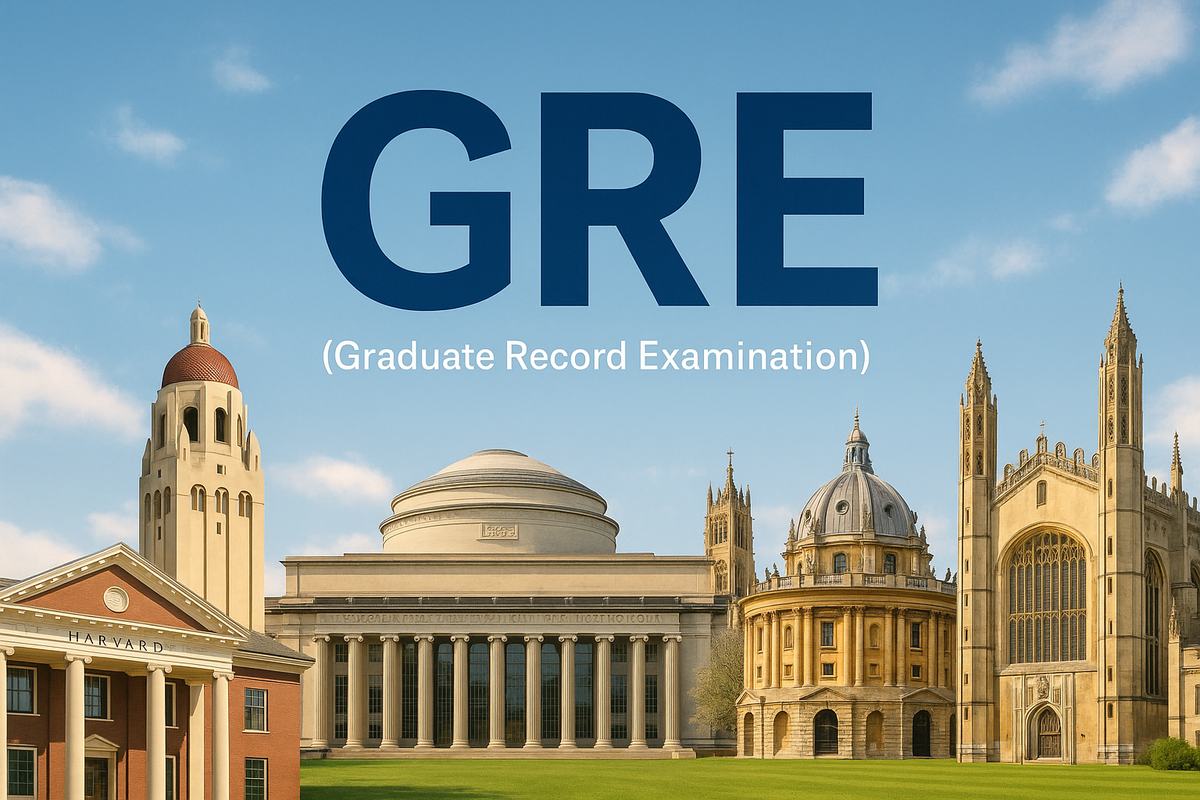
The Graduate Record Examination (GRE) is a standardized test conducted by Educational Testing Service (ETS), designed to measure verbal reasoning, quantitative reasoning, analytical writing, and critical thinking skills. The GRE is accepted by thousands of graduate and business schools worldwide, making it one of the most important gateway exams for advanced degree programs.
The GRE is widely recognized by universities across the United States, Canada, Europe, Australia, and Asia for admission to Master's programs, MBA programs, specialized master's degrees, and doctoral (PhD) programs. With its comprehensive assessment of analytical and reasoning abilities, the GRE provides universities with a common measure to compare applicants from diverse educational backgrounds.
The revised GRE format has been streamlined to approximately 2 hours, making it more efficient while maintaining its rigorous assessment standards. Whether you're pursuing graduate studies in engineering, sciences, humanities, social sciences, business, or interdisciplinary fields, the GRE opens doors to prestigious institutions and programs worldwide.
📅 GRE Test Availability & Timeline
Test Frequency: Available year-round at authorized test centers
Registration: Register at least 2-3 weeks before your preferred test date
Test Attempts: Can take GRE up to 5 times within a rolling 12-month period
Retake Wait Period: Minimum 21 days between test attempts
Score Availability: Unofficial scores (Verbal & Quantitative) immediately after test
Official Score Reports: Available approximately within 2 weeks after test date
Score Validity: GRE scores are valid for 5 years from test date
GRE Exam Highlights
| Feature | Details |
|---|---|
| Exam Name | GRE (Graduate Record Examination) |
| Full Form | Graduate Record Examination |
| Conducting Body | Educational Testing Service (ETS) |
| Exam Level | International |
| Mode of Exam | Computer-Based Test (at test centers) and GRE at Home (online proctored) |
| Test Frequency | Available year-round |
| Official Website | https://www.ets.org/gre |
| Accepted By | Thousands of graduate and business schools worldwide |
| Score Validity | 5 Years from test date |
| Total Duration | Approximately 1 hour 58 minutes |
| Total Questions | 54 questions (27 Verbal + 27 Quantitative) + 1 Essay |
| Score Range | 260-340 (130-170 each for Verbal & Quantitative) + 0-6 for Analytical Writing |
GRE Exam Pattern
Revised GRE Format Features
Shorter Duration: Approximately 1 hour 58 minutes (reduced from previous format)
Three Main Sections: Analytical Writing, Verbal Reasoning, Quantitative Reasoning
Section-Adaptive: Second section difficulty adapts based on first section performance
Total Questions: 54 multiple-choice questions + 1 essay
| Section | No. of Questions | Duration | Score Range |
|---|---|---|---|
| Analytical Writing | 1 Essay Task | 30 minutes | 0-6 (half-point increments) |
| Verbal Reasoning - Section 1 | 12 questions | 18 minutes | 130-170 (combined) |
| Verbal Reasoning - Section 2 | 15 questions | 23 minutes | |
| Quantitative Reasoning - Section 1 | 12 questions | 21 minutes | 130-170 (combined) |
| Quantitative Reasoning - Section 2 | 15 questions | 26 minutes | |
| Total | 54 MCQs + 1 Essay | ~1 hour 58 minutes | 260-340 + 0-6 AWA |
Adaptive Testing: The second section of Verbal and Quantitative adapts based on your performance in the first section. Better performance leads to harder questions worth more points.
No Negative Marking: There is no penalty for incorrect answers, so attempt all questions.
Unscored Section: An unidentified experimental section may appear but won't count toward your score.
GRE Eligibility Criteria
Educational Qualification
No formal educational requirements - ETS does not specify any minimum educational qualification to take the GRE. However, since GRE is used for graduate school admissions, most test-takers have completed or are completing their bachelor's degree.
Age Limit
No age restriction - There is no minimum or maximum age limit to take the GRE. Anyone can register for and take the test regardless of age.
Number of Attempts
Maximum 5 attempts per 12-month period - You can take the GRE up to 5 times within any continuous rolling 12-month period. There must be at least 21 days between consecutive test attempts.
ID Requirements
Valid passport required for Indian citizens - For test-takers in India, only a valid passport is accepted as identification. The passport must be current and valid on the test date. Other forms of ID are not acceptable.
Nationality
Open to all nationalities - The GRE is available to test-takers worldwide. Both international students and domestic applicants can take the exam.
Academic Background
No specific major required - GRE is designed to assess general reasoning skills regardless of your field of study. Test-takers from all academic backgrounds (science, engineering, humanities, commerce, arts) can take the GRE.
GRE Section-wise Content
Section 1: Analytical Writing (30 minutes, 1 task)
Task Type: "Analyze an Issue"
In this section, you'll be presented with an opinion on an issue and instructions on how to respond. Your task is to develop a well-reasoned response to the issue presented.
Skills Assessed:
- Critical thinking and analytical writing abilities
- Ability to articulate complex ideas clearly and effectively
- Support ideas with relevant reasons and examples
- Sustain a well-focused, coherent discussion
- Control elements of standard written English
Scoring: Scored on a scale of 0-6 in half-point increments. Essays are evaluated by trained readers and e-rater scoring engine.
Section 2: Verbal Reasoning (41 minutes total, 27 questions)
Question Types:
- Reading Comprehension: Questions based on passages from various academic disciplines. Tests ability to understand, analyze, and apply information.
- Text Completion: Fill in blanks in passages with the most appropriate words from multiple choices. Tests ability to understand context and word meaning.
- Sentence Equivalence: Select two answer choices that complete a sentence and create sentences with similar meanings. Tests vocabulary and sentence comprehension.
Skills Assessed:
- Understanding complex text and reasoning
- Analyzing and drawing conclusions from discourse
- Identifying author's assumptions and perspective
- Understanding multiple levels of meaning (literal, figurative, author's intent)
- Strong vocabulary and contextual understanding
Structure: Section 1 (12 questions, 18 minutes) | Section 2 (15 questions, 23 minutes)
Score Range: 130-170 in 1-point increments
Section 3: Quantitative Reasoning (47 minutes total, 27 questions)
Question Types:
- Quantitative Comparison: Compare two quantities (Quantity A and Quantity B) and determine their relationship.
- Multiple Choice (Single Answer): Select one correct answer from five choices.
- Multiple Choice (Multiple Answers): Select all correct answers from a list of choices.
- Numeric Entry: Enter your answer as an integer or decimal without answer choices.
- Data Interpretation: Interpret data from graphs, tables, and charts to answer questions.
Content Areas:
- Arithmetic: Properties of integers, fractions, decimals, percentages, ratios, rates, sequences, exponents, roots
- Algebra: Operations with exponents, algebraic expressions, equations and inequalities, linear and quadratic equations, word problems
- Geometry: Lines, angles, triangles, circles, quadrilaterals, 3D figures, coordinate geometry
- Data Analysis: Basic statistics, probability, distributions, data interpretation, counting methods, Venn diagrams
Structure: Section 1 (12 questions, 21 minutes) | Section 2 (15 questions, 26 minutes)
Score Range: 130-170 in 1-point increments
Calculator: On-screen calculator provided during Quantitative sections
GRE Score Interpretation & Percentiles
Understanding GRE Scores
Score Components: You receive three separate scores - Verbal Reasoning (130-170), Quantitative Reasoning (130-170), and Analytical Writing (0-6)
Total Score: Combined Verbal + Quantitative score ranges from 260-340
Percentile Ranks: Show how your scores compare to other test-takers globally
Score Reporting: Scores valid for 5 years; you choose which scores to send to schools (ScoreSelect option)
| Score Range | Percentile (Approx.) | Score Interpretation |
|---|---|---|
| 330-340 | 98-99+ percentile | Exceptional - Top-tier universities (Ivy League, Stanford, MIT) |
| 320-329 | 90-97 percentile | Excellent - Highly competitive programs at top universities |
| 310-319 | 75-89 percentile | Very Good - Quality graduate programs at reputable universities |
| 300-309 | 50-74 percentile | Good - Wide range of graduate program options |
| 290-299 | 30-49 percentile | Average - Many graduate programs still accessible |
| Below 290 | Below 30 percentile | Below Average - Limited options; consider retaking |
Section-Specific Score Benchmarks
| Section | Competitive Score | Excellent Score | Top-Tier Score |
|---|---|---|---|
| Verbal Reasoning | 155-159 (70-80%ile) | 160-164 (85-90%ile) | 165+ (95+%ile) |
| Quantitative Reasoning | 160-164 (70-80%ile) | 165-168 (85-93%ile) | 169-170 (97+%ile) |
| Analytical Writing | 4.0-4.5 (55-75%ile) | 5.0-5.5 (85-95%ile) | 6.0 (99%ile) |
Top Universities & GRE Score Requirements
| University Tier | Location | Typical GRE Range | Program Examples |
|---|---|---|---|
| Top-Tier (Ivy League) | USA | 325-340 | Stanford, MIT, Harvard, Princeton, Yale, Columbia |
| Highly Competitive | USA/UK | 320-330 | UC Berkeley, Cornell, UPenn, Carnegie Mellon, Oxford, Cambridge |
| Competitive Programs | USA/Canada/UK | 310-320 | Top 50 US universities, University of Toronto, McGill, LSE |
| Quality Programs | USA/Europe/Australia | 300-315 | Top 100 universities, strong regional programs |
| Standard Admissions | Global | 290-305 | Wide range of accredited graduate programs |
GRE Requirements by Field of Study
Engineering & Computer Science: Emphasis on Quantitative (typically 165+), Verbal around 155+
Natural Sciences (Physics, Chemistry, Biology): High Quantitative scores (163+), Verbal 155+
Business & MBA Programs: Balanced scores, typically 320+ total for top programs
Social Sciences (Psychology, Economics): Strong Verbal (158+) and Quantitative (160+)
Humanities (Literature, History, Philosophy): High Verbal emphasis (160+), AWA 5.0+
Education Programs: Moderate scores acceptable, typically 300-315 total
Why Take the GRE?
Key Benefits & Opportunities
1. Global Recognition - Accepted by thousands of graduate and business schools in over 160 countries worldwide, providing unparalleled access to international education.
2. Widest Program Acceptance - Used for admissions to Master's, MBA, specialized master's, doctoral programs, and even some business school programs that traditionally required GMAT.
3. ScoreSelect Flexibility - You control which scores to send to schools. Take the test multiple times and send only your best scores to institutions.
4. Test Format Options - Available at test centers worldwide and as GRE at Home (online proctored test), providing maximum convenience and flexibility.
5. Year-Round Availability - Unlike many entrance exams with fixed dates, GRE is available throughout the year, allowing you to choose test dates that fit your schedule.
6. Long Score Validity - GRE scores are valid for 5 years, giving you flexibility in your graduate school timeline and multiple application cycles.
7. Fair & Unbiased Assessment - Designed to measure developed abilities regardless of educational or cultural background, providing equal opportunity to all test-takers.
8. No Negative Marking - Unlike many standardized tests, GRE has no penalty for incorrect answers, encouraging you to attempt all questions.
9. Section-Adaptive Testing - Adaptive format ensures you're challenged at the appropriate level, providing a more accurate assessment of your abilities.
10. Comprehensive Skill Assessment - Evaluates critical thinking, analytical writing, verbal reasoning, and quantitative reasoning - all essential for graduate-level success.
11. Free Official Preparation - ETS provides free official practice tests, sample questions, and preparation materials, making quality prep accessible to everyone.
12. Fellowship & Scholarship Opportunities - Many graduate programs use GRE scores for fellowship and scholarship decisions. High scores can significantly reduce your education costs.
GRE vs Other Graduate Entrance Exams
GRE vs GMAT
| Feature | GRE | GMAT |
|---|---|---|
| Primary Purpose | Graduate school admissions (all fields) | Business school/MBA admissions |
| Conducting Body | Educational Testing Service (ETS) | Graduate Management Admission Council (GMAC) |
| Score Range | 260-340 (Verbal + Quant) + 0-6 AWA | 200-800 total score |
| Test Duration | ~2 hours | ~2.25 hours |
| Sections | Analytical Writing, Verbal, Quantitative | Quantitative, Verbal, Integrated Reasoning, AWA |
| Math Difficulty | More straightforward, calculator provided | More complex, no calculator |
| Verbal Focus | Vocabulary-based, reading comprehension | Grammar, sentence correction, critical reasoning |
| Adaptive Nature | Section-level adaptive | Question-level adaptive |
| Acceptance | Most graduate programs, many business schools | Primarily business schools, some specialized programs |
| Best For | Students pursuing any graduate degree, those with strong vocabulary | Students focused specifically on MBA/business programs |
Verdict: Choose GRE if you want maximum flexibility in program choices or are stronger in vocabulary. Choose GMAT if you're certain about MBA and prefer grammar-based verbal questions. Many business schools now accept both.
GRE vs TOEFL
| Feature | GRE | TOEFL |
|---|---|---|
| Purpose | Measures academic readiness for graduate programs | Measures English language proficiency |
| Who Takes It | All applicants to graduate programs | Only non-native English speakers |
| Skills Tested | Analytical, verbal, quantitative reasoning | Reading, listening, speaking, writing in English |
| Score Range | 260-340 + 0-6 AWA | 0-120 (30 points per section) |
| Speaking Test | No speaking component | Yes - speaking section included |
| When Required | For admission consideration to programs | To prove English language competency |
| Can You Take Both | Yes - international students often need both GRE (for admission) and TOEFL (for English proficiency) | |
Key Difference: GRE and TOEFL serve complementary purposes. GRE assesses your readiness for graduate-level academics, while TOEFL proves your English communication ability. International students typically need both.
GRE Preparation Strategy
Recommended Preparation Timeline
Ideal Preparation Period: 2-4 months (8-12 weeks) with 2-3 hours daily study
Phase 1: Diagnostic & Foundation (Weeks 1-2)
- Take a full-length diagnostic test to identify strengths and weaknesses
- Review GRE format, question types, and scoring system
- Learn basic strategies for each section
- Create a personalized study plan based on diagnostic results
Phase 2: Content Mastery (Weeks 3-8)
- Study content systematically - dedicate specific days to each section
- Build vocabulary using flashcards and word lists (15-20 words daily)
- Practice quantitative concepts with increasing difficulty
- Read high-quality publications to improve reading comprehension
- Take section-specific practice tests weekly
- Review mistakes thoroughly and understand error patterns
Phase 3: Practice & Refinement (Weeks 9-11)
- Take full-length practice tests every week under timed conditions
- Focus heavily on weak areas identified in practice tests
- Practice Analytical Writing essays and get feedback
- Master time management for each section
- Review all incorrect answers and understand why
Phase 4: Final Preparation (Week 12)
- Take final full-length practice test
- Light review of difficult concepts and vocabulary
- Rest well and avoid studying heavily 1-2 days before test
- Review test day procedures and requirements
Section-Wise Preparation Tips
For Verbal Reasoning:
- Build vocabulary systematically - focus on high-frequency GRE words
- Read challenging materials from academic journals, The Economist, Scientific American
- Practice active reading - summarize paragraphs, identify main ideas
- Learn roots, prefixes, and suffixes to decode unfamiliar words
- Time yourself - aim for 1-1.5 minutes per question
For Quantitative Reasoning:
- Review fundamental math concepts from arithmetic, algebra, geometry, and data analysis
- Master the on-screen calculator - know when to use it and when mental math is faster
- Practice estimation techniques for quick elimination of answer choices
- Work through official GRE math review materials
- Focus on word problems - they're common and can be tricky
For Analytical Writing:
- Practice writing timed essays on sample prompts
- Develop a clear structure: Introduction, body paragraphs with examples, conclusion
- Focus on clarity and coherence over vocabulary complexity
- Use specific examples to support your arguments
- Leave 2-3 minutes for proofreading
Time Management During the Test
- Analytical Writing (30 min): Spend 2-3 minutes planning, 23-25 minutes writing, 2-3 minutes reviewing
- Verbal Section 1 (18 min/12 questions): Aim for 1.5 minutes per question, mark difficult ones for review
- Verbal Section 2 (23 min/15 questions): Maintain similar pace, prioritize easier questions first
- Quant Section 1 (21 min/12 questions): Approximately 1.75 minutes per question
- Quant Section 2 (26 min/15 questions): Similar pace, use calculator strategically
- No Penalty Strategy: Since there's no negative marking, never leave questions blank - make educated guesses
Free Official Preparation Resources
- POWERPREP Online: Two free full-length practice tests from ETS that simulate the actual test
- Official GRE Super Power Pack: Comprehensive guide with strategies and practice questions
- GRE Math Review: Free PDF covering all quantitative topics
- Pool of Issue Topics: All possible Analytical Writing prompts available for practice
- ETS GRE Prep Mobile App: Practice questions and strategies on the go
Mathematica Complete Education
Your Partner in Excellence
IIM Indore Alumnus Mentorship
Online & Offline Classes
20+ Years Teaching Experience
Personalized Study Plans
Full-Length Mock Tests
10,000+ Students Succeed
📍 307, Sai Ram Plaza, Bhawarkuan, Indore
📞 93021-32363 | 🌐 mathematicaindia.com

Dharmendra Gupta
Chief Mentor | IIM Indore Alumnus
📚 20+ Years Teaching
🎓 10,000+ Students Succeed
GRE Frequently Asked Questions
Career Opportunities After GRE-Based Graduate Programs
Graduate Degree Programs Accessible Through GRE
STEM Fields:
- Master's in Computer Science, Data Science, Artificial Intelligence
- Engineering programs (Electrical, Mechanical, Civil, Chemical)
- Natural Sciences (Physics, Chemistry, Biology, Environmental Science)
- Mathematics, Statistics, Applied Mathematics
- Research-focused PhD programs
Business & Management:
- MBA programs at top business schools
- Master's in Finance, Accounting, Business Analytics
- Master's in Management, International Business
- Specialized programs in Marketing, Operations
Social Sciences & Humanities:
- Psychology, Sociology, Anthropology programs
- Economics, Public Policy, International Relations
- Literature, History, Philosophy programs
- Education, Teaching, Curriculum Development
Professional Programs:
- Public Health (MPH), Healthcare Administration
- Public Administration (MPA), Policy Studies
- Communication, Journalism, Media Studies
- Architecture, Urban Planning, Design
Career Outcomes & Opportunities
Industry Sectors:
- Technology: Software engineering, data science, AI/ML, research & development
- Consulting: Management consulting, strategy, business analysis with top firms
- Finance: Investment banking, financial analysis, portfolio management
- Academia & Research: University professorships, research institutions, think tanks
- Government & Policy: Civil services, policy research, international organizations
- Healthcare: Hospital administration, public health, pharmaceutical companies
- Entrepreneurship: Starting ventures backed by strong graduate education
Graduate degrees obtained through GRE-based admissions open doors to leadership positions, research opportunities, and specialized roles across industries globally. The credential is highly valued by employers worldwide.
Official Resources & Important Links
Official GRE Resources
Official ETS GRE Website: https://www.ets.org/gre
Register for GRE: https://www.ets.org/mygre
Free Practice Tests: POWERPREP Online available on ETS website
GRE at Home Information: Check ETS website for technical requirements and guidelines
Analytical Writing Topics: Pool of issue topics available on ETS website
Official Prep Materials: Official GRE Super Power Pack, GRE Math Review
Contact ETS: Support available through official website and regional offices