
MAT Exam: Gateway to 800+ Business Schools
Your Complete Guide to the Management Aptitude Test
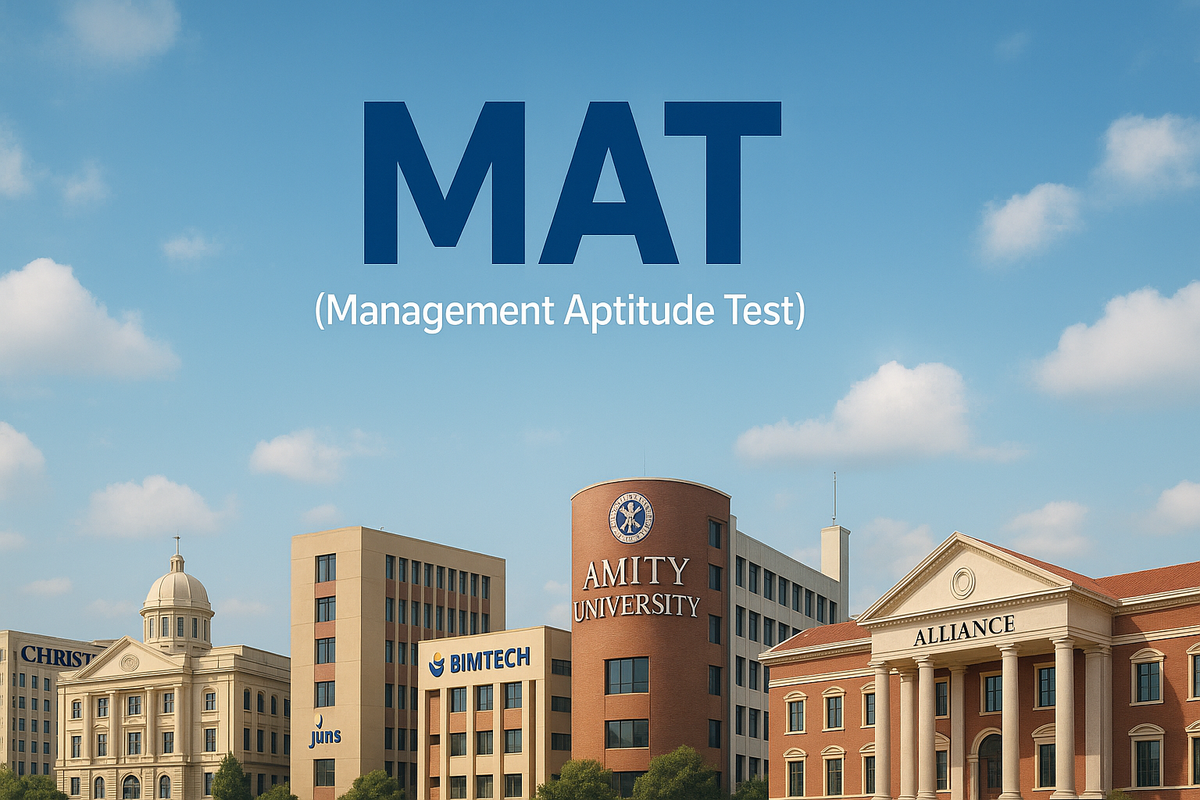
The Management Aptitude Test (MAT) is a national-level management entrance examination conducted by the All India Management Association (AIMA), one of India's oldest and most reputed business associations. Unlike CAT which is conducted once yearly, MAT is held four times annually (February, May, September, and December), providing candidates multiple opportunities to improve their scores within a single academic year.
MAT is accepted by over 800 AICTE-approved MBA and PGDM colleges across India, making it one of the most widely accepted management entrance exams in the country. The exam is designed to assess a candidate's aptitude in quantitative reasoning, language skills, logical thinking, data interpretation, and awareness of current business and economic developments.
With its lower difficulty level compared to CAT and flexibility in multiple attempts, MAT is an excellent option for aspirants seeking admission to quality MBA programs across India. The exam offers three test modes - Paper-Based Test (PBT), Computer-Based Test (CBT), and Internet-Based Test (IBT) - allowing candidates to choose based on their comfort level.
📅 MAT Exam Schedule (4 Sessions Annually)
December Session: Registration opens in early December, Exam typically in mid-to-late December
February Session: Registration opens in early January, Exam typically in mid-to-late February
May Session: Registration opens in early April, Exam typically in May
September Session: Registration opens in August, Exam typically in September
MAT Exam Highlights
| Feature | Details |
|---|---|
| Exam Name | MAT (Management Aptitude Test) |
| Full Form | Management Aptitude Test |
| Conducting Body | All India Management Association (AIMA) |
| Exam Level | National |
| Mode of Exam | Paper-Based Test (PBT), Computer-Based Test (CBT), Internet-Based Test (IBT) |
| Frequency | Four times a year (February, May, September, December) |
| Official Website | https://www.aima.in |
| Accepted By | 800+ AICTE-approved MBA/PGDM colleges |
| Score Validity | 1 Year |
| Language | English only |
| Total Questions | 150 (Multiple Choice Questions) |
| Total Marks | 150 marks |
| Exam Duration | 120 minutes (2 hours) |
Latest MAT Exam Pattern
| Section | No. of Questions | Marks Per Question | Maximum Marks |
|---|---|---|---|
| Language Comprehension | 30 | 1 | 30 |
| Intelligence & Critical Reasoning | 30 | 1 | 30 |
| Mathematical Skills | 30 | 1 | 30 |
| Data Analysis & Sufficiency | 30 | 1 | 30 |
| Economic & Business Environment | 30 | 1 | 30 |
| Total | 150 Questions | - | 150 Marks |
Marking Scheme:
• Correct Answer: +1 mark
• Incorrect Answer: -0.25 marks
• Unanswered Question: No deduction (0 marks)
Question Format: All questions are in Multiple Choice (MCQ) format with 4 answer options each.
No Sectional Time Limit: Candidates can freely navigate between sections and manage time as per their strategy.
Important Note: Economic & Business Environment section is NOT included in the final percentile calculation, though it carries 30 marks.
MAT Eligibility Criteria
Educational Qualification
Bachelor's degree in any discipline from a recognized university. Professional degree holders (CA, CS, ICWA) are also eligible. Final-year candidates can apply, provided their graduation will be completed before MBA program commencement.
Age Limit
No upper age restriction - candidates of any age can apply. No minimum age specified either.
Academic Performance
No minimum percentage requirement by AIMA. However, individual colleges may have their own minimum percentage criteria for admission.
Work Experience
Not required to take the exam. Some MBA programs may prefer candidates with work experience, but it's not mandatory for appearing in MAT.
Number of Attempts
Unlimited attempts - Candidates can appear for MAT as many times as they wish. AIMA typically considers the best score from multiple attempts for admission.
Nationality
Open to Indian citizens and international students.
MAT Section-wise Syllabus
Section 1: Language Comprehension (30 Questions, 30 Marks)
Verbal Ability Topics:
- Parts of Speech (Nouns, Verbs, Adjectives, Adverbs, Pronouns)
- Grammar and Tenses
- Vocabulary (Synonyms, Antonyms, Word Associations)
- Idioms and Phrases
- Fill in the Blanks
- Sentence Correction
- Para-jumbles and Logical Sequencing
Reading Comprehension Topics:
- Central Ideas and Themes
- Inference-based Questions
- True/False Statements based on passage content
- Questions on author's tone and purpose
Difficulty Level: Easy to Moderate | Highest Scoring Section: 80-85% accuracy achievable
Section 2: Intelligence & Critical Reasoning (30 Questions, 30 Marks)
Logical Reasoning Topics:
- Series and Number Sequences
- Puzzles and Logic Problems
- Coding-Decoding
- Blood Relations and Family Trees
- Syllogisms and Logical Deduction
- Arrangement Problems (Circular, Linear)
- Multi-dimensional Arrangements
Analytical Reasoning Topics:
- Course of Action
- Statement Assumptions
- Critical Reasoning and Inference
- Cause and Effect
- Visual Reasoning and Pattern Recognition
- Clocks and Calendars
- Directions and Navigation
Difficulty Level: Moderate | Topper Accuracy: 75-80%
Section 3: Mathematical Skills (30 Questions, 30 Marks)
- Number System: LCM, HCF, Prime Numbers, Complex Numbers
- Arithmetic: Percentages, Profit-Loss, Simple & Compound Interest, Speed-Time-Distance
- Algebra: Equations, Linear Programming, Sequences & Series, Binomial Theorem, Inequalities
- Geometry: Circles, Heights & Distances, Set Theory, Venn Diagrams
- Commercial Mathematics: Ratios, Proportions, Mixtures & Alligations
- Indices and Surds: Surds & Indices, Exponents
Special Note: Approximately 45-50% questions are based on Arithmetic, making it the most important subsection.
Difficulty Level: Easy to Moderate | Topper Accuracy: 70-75%
Section 4: Data Analysis & Sufficiency (30 Questions, 30 Marks)
Data Analysis Topics (Approximately 20-25 Questions):
- Data Interpretation from Tables, Bar Graphs, Pie Charts, Line Graphs
- Caselets and Business Scenarios
- Percentages, Percent Change, Ratios
- Averages and Aggregates
- Comparative Analysis of Data Sets
- Approximately 4-5 sets with 4-5 questions each
Data Sufficiency Topics (Approximately 5-10 Questions):
- Determining whether provided statements contain sufficient information
- Evaluating data adequacy and relevance
- Decision-making based on data constraints
- Comparing Quantities
Difficulty Level: Moderate | Topper Accuracy: 75-80%
Section 5: Economic & Business Environment (30 Questions, 30 Marks)
- Current Affairs: Recent economic policies, international trade developments, major financial news, political developments
- Business & Economy: Business trends, corporate news, market movements, startup developments
- Static General Knowledge: Economics concepts (inflation, GDP, fiscal/monetary policy), business terminology, major companies and industries
- Indian & Global Developments: Socio-economic trends, cultural developments, international relations
Recommended Sources:
- The Economic Times
- The Hindu Business Line
- Business Today Magazine
- Official government policy announcements
- RBI and Ministry of Finance notifications
Difficulty Level: Easy | Topper Accuracy: 85-90%
MAT Score Interpretation & Percentiles
MAT Scoring System
Raw Marks: 0-150 marks (based on actual test performance)
Composite Score: 0-800 scale (after statistical normalization)
Percentile Range: 0-99.99 percentile
| MAT Composite Score | Percentile (Approx.) | Interpretation |
|---|---|---|
| 600+ | 85-90 | Excellent score; eligible for top-tier colleges |
| 500-600 | 70-85 | Good score; eligible for quality mid-tier colleges |
| 400-500 | 60-70 | Moderate score; several colleges available |
| Below 400 | Below 60 | Limited options; may need to focus on value colleges |
Top MAT Accepting Colleges & Expected Cut Offs
| College Name | Location | Expected Cut Off | Placement Quality |
|---|---|---|---|
| BIMTECH | Greater Noida | 95+ | Excellent - Top-tier packages |
| XIME Bangalore | Bangalore | 94-96 | Excellent - High average placements |
| Woxsen University | Hyderabad | 90+ | Excellent - Strong international placements |
| Jaipuria Institute of Management | Noida | 90+ | Very Good - Competitive packages |
| ISB&M Pune | Pune | 85+ | Very Good - Consistent placements |
| JAGSoM Bangalore | Bangalore | 90+ | Very Good - Competitive packages |
| Christ University | Bangalore | 85+ | Good - Reputable companies |
| SIES Mumbai | Mumbai | 80+ | Good - Decent packages |
| IBA Bangalore | Bangalore | 80+ | Good - Regular placements |
| Rajagiri Business School | Kochi | 75+ | Good - Quality placements |
| PSG Institute of Management | Coimbatore | 90+ | Good - Competitive packages |
Government Colleges Accepting MAT
| College | Location | Expected Cut Off | Fee Structure | Placement Quality |
|---|---|---|---|---|
| NIT Rourkela | Odisha | 90+ | Very Low - Government rates | Excellent - Top packages |
| MNIT Jaipur | Rajasthan | 90+ | Very Low - Government rates | Excellent - Quality placements |
| NIT Warangal | Telangana | 85+ | Very Low - Government rates | Very Good - Regular placements |
| NIT Jalandhar | Punjab | 80+ | Very Low - Government rates | Very Good - Competitive packages |
| IISWBM Kolkata | West Bengal | 85+ | Low - Government rates | Good - Decent placements |
Why Take MAT?
Key Benefits & Opportunities
1. Multiple Attempts in a Year - Unlike CAT (once yearly) or CMAT (once yearly), MAT offers four chances annually (February, May, September, December) to improve your score.
2. Lower Difficulty Level - MAT is easier compared to CAT and moderately easier than CMAT, making it accessible to candidates from diverse academic backgrounds.
3. Flexible Test Modes - Choose between Paper-Based Test (PBT), Computer-Based Test (CBT), or Internet-Based Test (IBT) based on your comfort level.
4. No Sectional Time Limits - Freedom to navigate between sections and strategize time management as per individual strengths.
5. Broad College Acceptance - Over 800 MBA/PGDM colleges across India accept MAT scores, including both private and government institutions.
6. Government College Options - Several prestigious government colleges like NIT Rourkela, MNIT Jaipur, and NIT Warangal accept MAT, offering quality education at affordable fees.
7. Economic Section Optional - Economic & Business Environment section is not counted in final percentile, allowing candidates to focus on core sections without pressure.
8. Affordable Registration Fee - Significantly lower fees compared to GMAT and competitive with other national MBA entrance exams.
9. Instant Score Availability - MAT results are declared relatively quickly, allowing timely MBA program applications.
10. No Work Experience Mandatory - Unlike GMAT or international MBA programs, no prior work experience is required for taking the exam or for many MBA colleges.
11. Best Score Considered - If you take MAT multiple times, usually the best score from all attempts is sent to colleges, not cumulative scores.
12. Placement Opportunities - Top MAT colleges offer competitive average placements with internships and strong industry connections across various sectors.
MAT vs. Other MBA Entrance Exams
MAT vs. CAT
| Feature | MAT | CAT |
|---|---|---|
| Conducting Body | AIMA | Indian Institutes of Management (IIMs) |
| Frequency | 4 times a year (Feb, May, Sep, Dec) | Once yearly (November) |
| Mode | CBT, PBT, IBT | CBT only |
| Total Questions | 150 | 68 |
| Exam Duration | 120 minutes | 120 minutes |
| Sectional Time Limit | No time limit per section | 40 minutes per section |
| Marks Per Correct Answer | +1 | +3 |
| Negative Marking | -0.25 | -1 |
| Difficulty Level | Easy to Moderate | Moderate to High |
| Colleges Accepting | 800+ | 20 IIMs + 1,200+ B-Schools |
Verdict: MAT is better if you want multiple attempts, easier difficulty, and broader college acceptance. CAT is better for IIM admission and higher-tier colleges.
MAT vs. CMAT
| Feature | MAT | CMAT |
|---|---|---|
| Conducting Body | AIMA | National Testing Agency (NTA) |
| Frequency | 4 times yearly | Once yearly (January) |
| Mode | CBT, PBT, IBT | CBT only |
| Total Questions | 150 | 100 |
| Exam Duration | 120 minutes | 180 minutes (3 hours) |
| Time per Question | ~48 seconds | ~108 seconds |
| Difficulty Level | Easy to Moderate | Easy to Moderate |
| Negative Marking | -0.25 per wrong | -1 per wrong |
| Colleges Accepting | 800+ | 1,300+ |
| Marks Per Correct | +1 | +4 |
Verdict: CMAT offers more time per question and broader college acceptance. MAT provides more attempts and multiple test modes.
MAT Preparation Strategy
Ideal Time Allocation & Target Scores for 90+ Percentile
| Section | Ideal Time | Questions to Attempt | Target Score |
|---|---|---|---|
| Language Comprehension | 30 minutes | 25-30 | 27-28 |
| Intelligence & Critical Reasoning | 40 minutes | 25-28 | 27 |
| Mathematical Skills | 40 minutes | 30-32 | 30 |
| Data Analysis & Sufficiency | 35 minutes | 24-28 | 23 |
| Economic & Business Environment | 15 minutes | 15-25 | Not counted |
| Total | 120 minutes | 108-110 | 108-110 |
Key Preparation Tips
- Focus on Accuracy: With negative marking of -0.25, aim for 75-80% accuracy across sections
- Leverage Multiple Attempts: Use first attempt to understand exam pattern, second for scoring better, and subsequent attempts for improvement
- Master Time Management: With 150 questions in 120 minutes (~48 seconds per question), speed is critical
- Prioritize Sections: Focus more on Language Comprehension (highest scoring) and Economic Environment (easiest)
- Practice Data Interpretation Sets: Caselets are increasingly common; practice multiple caselet-based DI sets
- Strengthen Arithmetic: 45-50% of Mathematical Skills are arithmetic-based; master this subsection
- Use Mock Tests: Practice with official AIMA mock tests and past papers
- Selective Attempt Strategy: Don't attempt questions you're unsure about due to negative marking
Mathematica Complete Education
Your Partner in Excellence
IIM Indore Alumnus Mentorship
Online & Offline Classes
20+ Years Teaching Experience
Personalized Study Plans
Full-Length Mock Tests
10,000+ Students Succeed
📍 307, Sai Ram Plaza, Bhawarkuan, Indore
📞 93021-32363 | 🌐 mathematicaindia.com

Dharmendra Gupta
Chief Mentor | IIM Indore Alumnus
📚 20+ Years Teaching
🎓 10,000+ Students Succeed
MAT Frequently Asked Questions
Success Stories & Placement Outcomes
Average Placements from Top MAT Colleges
- BIMTECH: Strong average placements with competitive packages from top companies
- XIME Bangalore: Excellent placement records with attractive salary packages
- Woxsen University: Impressive average packages with strong international placements
- ISB&M Pune: Consistent placement performance across industry sectors
- Christ University: Good average placements with reputable companies
- Government Colleges: Quality placements with significantly lower program fees
Top Recruiting Companies: Deloitte, EY, PwC, KPMG, HDFC Bank, ICICI Bank, TCS, Wipro, Infosys, HUL, Amazon, Flipkart, Microsoft, and Google (for top colleges)
Key Resources & Contacts
Official Resources
Official AIMA MAT Website: https://www.aima.in
Registration Portal: https://mat.aima.in
Download MAT Syllabus & Previous Papers: Available on official AIMA website
Practice Mock Tests: Official mocks available on AIMA portal
Participating Colleges: Full list updated regularly on AIMA website
Contact AIMA: Available through official website contact forms and helplines